What Is Gymnastics? A Complete History of the Sport

What Is Gymnastics? A Complete History of the Sport
What Is Gymnastics?
You've probably watched it during the Olympics.
A gymnast explodes down the runway toward the vault.
Another swings around the uneven bars.
A men's competitor seems to defy gravity on the rings.
A floor routine combines tumbling, strength, flexibility, artistry and extraordinary body control.
But what exactly is gymnastics?
And how did humans go from physical exercises thousands of years ago to the highly technical sport we know today?
Gymnastics has a remarkably long history. Its roots extend into antiquity, while the organized competitive sport familiar today largely developed in Europe during the 18th and 19th centuries. The international federation governing gymnastics was established in 1881, and gymnastics appeared at the first modern Olympic Games in 1896.
For Grand Prairie parents researching gymnastics classes for kids, understanding that history also reveals something important:
Many of the fundamental physical qualities associated with gymnastics, including strength, balance, coordination, body awareness and controlled movement, aren't exclusive to gymnastics.
And that brings us to a much newer sport:
Ninja Warrior.
What Does the Word "Gymnastics" Actually Mean?
Modern gymnastics encompasses much more than the floor routines and apparatus most people see during the Olympics.
Today, the international governing body, World Gymnastics, governs eight disciplines:
Men's Artistic Gymnastics
Women's Artistic Gymnastics
Rhythmic Gymnastics
Trampoline & Tumbling
Acrobatic Gymnastics
Aerobic Gymnastics
Gymnastics for All
Parkour
The federation has more than 160 national member federations.
So when someone says "gymnastics," they may actually be describing several substantially different forms of movement and competition.
Where Did Gymnastics Begin?
Ancient Civilizations and Physical Exercise
The history goes back thousands of years.
World Gymnastics reports that forms of gymnastic exercise were practiced in China as early as roughly 4,000 years ago for health and longevity.
But ancient Greece is especially important to the development and identity of gymnastics.
Physical fitness occupied an important place within ancient Greek culture. Activities associated with gymnastics included fundamental athletic movements such as running and jumping.
The Greeks valued physical development alongside broader ideas about education and human development.
This is also where the historical relationship between the words gymnasium and gymnastics begins.
The modern gymnastics facility filled with spring floors, beams and bars obviously didn't exist in the form parents recognize today.
Gymnastics evolved enormously over the centuries.
The Romans Adapted Gymnastics for Military Preparation
The Romans adopted physical training traditions but placed significant emphasis on military preparation.
According to World Gymnastics' official history, gymnastics exercises were used to physically prepare Roman soldiers. The organization traces the historical predecessor of the pommel horse to exercises intended to develop mounting and dismounting skills for horseback riding.
That's an interesting connection.
An apparatus that today showcases extraordinarily technical Olympic routines has historical links to practical physical preparation.
And it illustrates something that continues throughout gymnastics history:
Training the body to become stronger, more coordinated and more capable.
Gymnastics Declines in Europe
Gymnastics did not simply progress continuously from ancient Greece into the Olympics.
There was an enormous historical gap.
World Gymnastics notes that after the suppression of the ancient Olympic Games near the end of the fourth century, formal gymnastics largely disappeared in Europe for a very long period, although tumbling and acrobatic performance survived in various forms.
The foundations of what we'd recognize as modern gymnastics would emerge much later.

The Revival of Physical Education
During the Enlightenment and the centuries surrounding it, European thinkers increasingly revisited ideas connecting physical activity, education, health and the development of the individual.
Gymnastics began moving toward a more systematic form of physical education.
Important figures associated with this broader movement included Johann Heinrich Pestalozzi, Jean-Jacques Rousseau, Friedrich Ludwig Jahn and Per Henrik Ling.
Different systems emphasized different approaches to physical education.
But one individual became especially important to modern gymnastics.
Friedrich Ludwig Jahn and Modern Gymnastics
German educator Friedrich Ludwig Jahn (1778–1852) is commonly described as one of the central founders of modern gymnastics.
World Gymnastics identifies Jahn as the "father of modern Gymnastics" and credits him with establishing foundations and rules for organized group exercise.
His approach was associated with Turnen, a German physical-culture movement.
Gymnastics clubs inspired by Jahn's outdoor Turnplatz spread through Germany and eventually beyond Europe. World Gymnastics reports that gymnastics clubs had reached the United States by the mid-1820s.
Gymnastics was becoming organized.
And once an activity becomes organized across clubs and countries, competition tends to follow.
The First National Gymnastics Federations
The 19th century brought another major development:
Formal organizations.
According to World Gymnastics, Switzerland established a national gymnastics federation in 1832, followed by organizations in countries including Germany, Belgium, Poland, Italy and France.
That created the infrastructure necessary for gymnastics to evolve from local physical-education traditions into an internationally organized sport.
1881: International Gymnastics Becomes Organized
This is one of the most important dates in gymnastics history.
On July 23, 1881, representatives from Belgium, France and the Netherlands established the organization that eventually became today's International Gymnastics Federation, now branded World Gymnastics.
Belgian gymnastics leader Nicolas J. Cupérus was its founder and first president.
World Gymnastics describes itself as the oldest established international federation of an Olympic sport.
Interestingly, Cupérus did not originally envision gymnastics primarily as a competitive sport. His philosophy emphasized physical activity for health and fitness. Competition became increasingly prominent as the organization developed.
1896: Gymnastics Enters the Modern Olympics
When the modern Olympic Games were revived in Athens in 1896, gymnastics was there.
At a pre-Olympic congress in Paris in 1894, gymnastics was approved as one of the nine sports on the program for the inaugural Athens Games.
That means gymnastics has been part of the modern Olympic movement from its beginning.
But the gymnastics performed in 1896 was not identical to what we watch today.
The sport continued evolving.
1903: The First World Championships
International competition continued expanding after the first modern Olympics.
The first international tournament recognized today as the World Artistic Gymnastics Championships was held in Antwerp in 1903.
By this point, gymnastics had transformed dramatically from its ancient origins.
It was becoming an internationally organized competitive sport.
When Did Women's Gymnastics Begin at the Olympics?
Women's gymnastics arrived later.
Women first competed in Olympic gymnastics in 1928. The early women's competition, however, looked considerably different from modern Women's Artistic Gymnastics.
The sport continued evolving over subsequent decades, particularly during the mid-20th century.
By the 1952 Helsinki Olympics, women's gymnastics had entered a more recognizable modern era, while men's competition had also settled around the six apparatus used today.
The Modern Era of Gymnastics
The postwar decades produced extraordinary changes in gymnastics.
Soviet and Japanese programs helped push artistic gymnastics toward increasingly sophisticated combinations of artistry, technique, difficulty and originality.
New skills emerged.
Training became increasingly specialized.
Equipment evolved.
Judging evolved.
Athletes continually expanded what seemed physically possible.
1976: The Perfect 10 Becomes Part of Sports History
One of gymnastics' most famous moments came at the 1976 Montreal Olympics.
Nadia Comăneci's perfect-10 performances became an iconic chapter in Olympic gymnastics history, while Nellie Kim also recorded perfect 10s at those Games. World Gymnastics notes that both athletes were only 14 years old at the time.
The sport's visibility exploded.
Gymnastics had become one of the signature spectacles of the Olympic Games.
Gymnastics Continues to Evolve
Gymnastics never stopped changing.
World Gymnastics notes that specialist participation expanded beginning in 1992, allowing elite gymnasts to focus on fewer apparatus. A redesigned vaulting table was introduced in 2001, replacing the older vault horse as the sport continued responding to technical development and safety considerations.
Today, elite gymnastics is extraordinarily specialized.
But underneath that specialization remain several fundamental qualities that parents immediately recognize.
Strength.
Balance.
Coordination.
Power.
Body control.
Spatial awareness.
Movement skill.
What Events Are in Artistic Gymnastics?
When most Americans say "gymnastics," they're usually thinking about Artistic Gymnastics.
Women's Artistic Gymnastics includes four apparatus:
Vault
Uneven Bars
Balance Beam
Floor Exercise
Men's Artistic Gymnastics includes six:
Floor Exercise
Pommel Horse
Still Rings
Vault
Parallel Bars
Horizontal Bar
But artistic gymnastics is only part of the modern gymnastics world.
Gymnastics vs. Tumbling: What's the Difference?
Parents often use these terms interchangeably, but they're not exactly the same thing.
Gymnastics is the broader sport.
Tumbling centers on acrobatic movements such as rolls, handsprings, flips and related skills performed through a sequence.
Tumbling exists within the larger gymnastics ecosystem and is formally governed internationally alongside trampoline by World Gymnastics.
So a child who loves tumbling may enjoy gymnastics.
But a child can also love climbing, swinging and athletic movement without wanting traditional gymnastics at all.
And that's where the conversation becomes particularly relevant for Grand Prairie parents.
What If My Child Likes Gymnastics, But Wants Something Different?
Maybe your child loves:
Climbing.
Swinging.
Jumping.
Balancing.
Running.
Hanging.
Learning physical skills.
Conquering challenges.
But traditional gymnastics isn't clicking.
That doesn't mean you should stop looking for an athletic program.
Try Ninja Warrior.
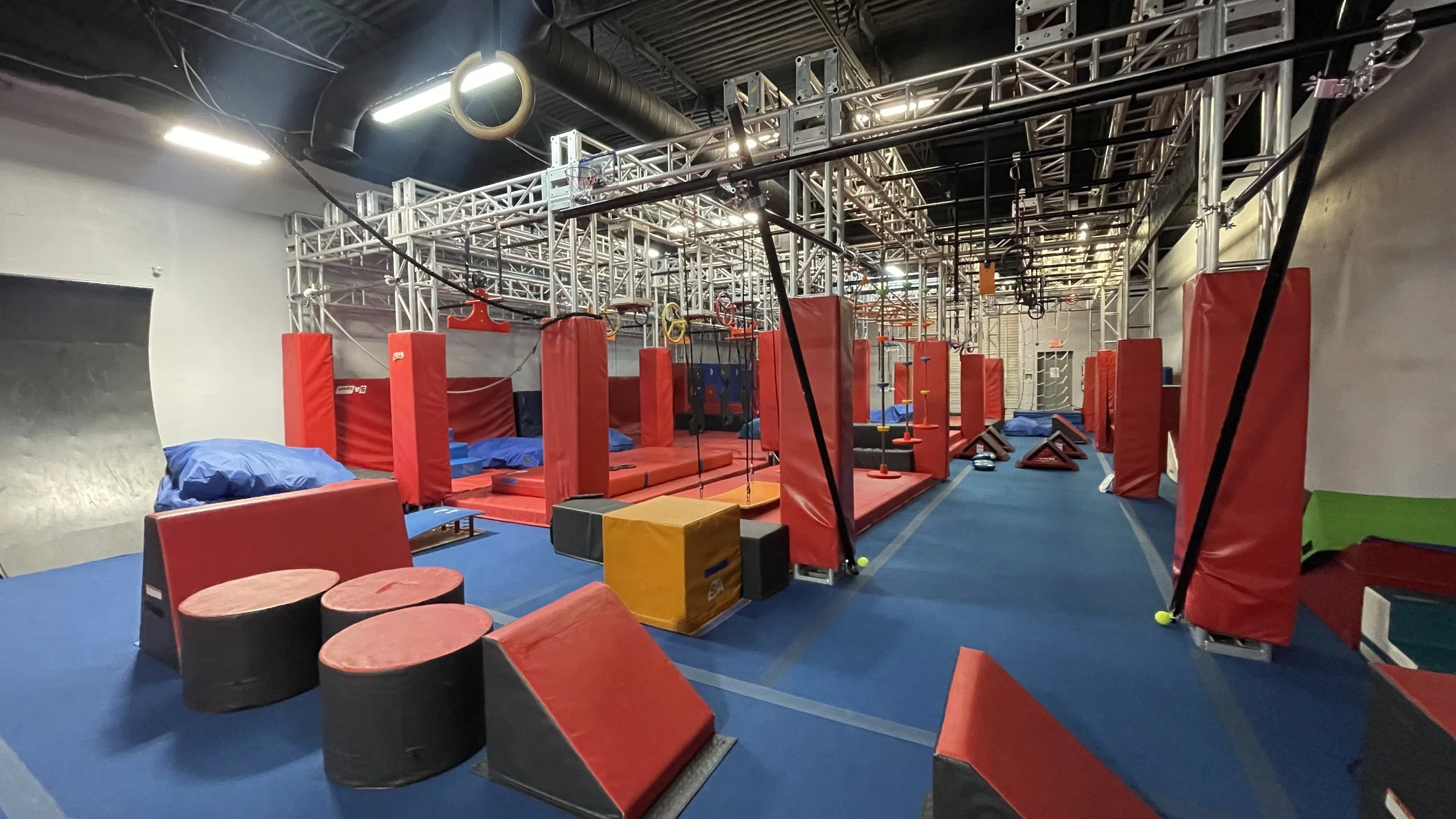
At Amped Obstacles - Grand Prairie, kids can experience structured obstacle-course training that draws upon many broad athletic qualities parents may also associate with gymnastics, while pursuing an entirely different activity.
Amped's youth program includes climbing, swinging, jumping, balancing, grip work, coordination and progressive obstacle skills.
Gymnastics and Ninja Warrior: Similarities and Differences
It's important not to pretend they're the same sport.
They're not.
A Ninja Warrior class does not replace gymnastics-specific coaching if your child's goal is competitive gymnastics.
A gymnastics program teaches gymnastics.
A Ninja Warrior program teaches Ninja Warrior.
But there is meaningful overlap in some of the underlying physical qualities each can challenge.
Both may involve:
Upper-body strength
Core control
Balance
Coordination
Body awareness
Jumping and landing
Hanging
Spatial problem-solving
Confidence with movement
The difference is how those qualities are applied.
A gymnast may learn a routine.
A Ninja athlete may learn how to navigate a sequence of obstacles.
The Kid Who Climbs Everything Might Be a Ninja
You know the child.
The playground isn't enough.
They're climbing the furniture.
Swinging from bars.
Jumping from one object to another.
Turning the living room into an obstacle course.
You may have assumed:
"Maybe I should put them in gymnastics."
And gymnastics may indeed be an excellent fit.
But there's another possibility.
Your kid might love Ninja Warrior.
Kids Ninja Warrior Classes in Grand Prairie, TX
Amped Obstacles offers structured youth Ninja programs for ages 3–17 in Grand Prairie. Classes are organized by age and progression rather than treating every child exactly the same.
Current age groups progress from introductory movement for younger children through increasingly advanced obstacle training for older kids and teens.
Training can involve:
Jumping
Crawling
Climbing
Balancing
Hanging
Swinging
Grip development
Obstacle navigation
Strength
Coordination
Endurance
Technique
The facility also uses a 10-level Ninja Skills progression system, providing kids with increasingly advanced skills to work toward.
Gymnastics Alternative for Kids in Grand Prairie, TX
Parents searching for:
Gymnastics Grand Prairie TX
Gymnastics classes Grand Prairie TX
Kids gymnastics Grand Prairie TX
Gymnastics for toddlers Grand Prairie TX
Tumbling Grand Prairie TX
Cheer Grand Prairie TX
Kids sports Grand Prairie TX
Kids fitness classes Grand Prairie TX
Ninja Warrior Grand Prairie TX
may ultimately be searching for something broader than a particular sport.
You may simply want a place where your child can:
Move.
Learn.
Become stronger.
Build coordination.
Gain confidence.
Make progress.
If that's the goal, Ninja Warrior deserves a place on your list.
What If My Child Already Does Gymnastics?
They don't necessarily have to choose.
A gymnast who enjoys trying different physical challenges may simply find Ninja Warrior fun.
Obstacle training can expose them to different grip challenges, climbing patterns, swinging obstacles and movement problems.
Likewise, a Ninja athlete might enjoy gymnastics.
Kids don't have to be placed into one athletic box.
Movement can be explored in many different ways.
What About Cheer, Dance and Tumbling?
The same principle applies.
A child participating in:
Cheer
Dance
Tumbling
Gymnastics
Soccer
Baseball
Softball
Football
Basketball
Volleyball
Swimming
Track
can still train Ninja Warrior.
Ninja training can be its own sport or simply another opportunity to develop and experience movement.
What If My Child Isn't "Athletic"?
They can still start.
Amped Obstacles states that its programming is designed for children of varying abilities and uses age-appropriate, structured coaching and progressions.
Your child doesn't need to arrive knowing how to swing across the rig.
They don't need a pull-up.
They don't need gymnastics experience.
They need somewhere to begin.
From Gymnastics History to the Future of Movement
Think about how far physical training has evolved.
Ancient civilizations practiced physical exercises thousands of years ago.
Ancient Greek culture placed significant value on physical development.
European educators later developed systematic physical-training methods.
Jahn helped establish foundations for modern gymnastics.
National federations formed.
An international federation arrived in 1881.
Gymnastics entered the modern Olympics in 1896.
Women's Olympic gymnastics followed in 1928.
The sport continued developing into the extraordinary athletic discipline we watch today.
And physical culture continues evolving.
Today, children have opportunities their parents and grandparents never had.
One of them is Ninja Warrior.
Frequently Asked Questions
What is gymnastics?
Gymnastics is a broad family of physical and competitive disciplines involving qualities such as strength, coordination, balance, flexibility, body control and technical skill. Modern World Gymnastics governs eight disciplines, ranging from Artistic and Rhythmic Gymnastics to Trampoline & Tumbling, Acrobatics and Parkour.
Where did gymnastics originate?
Forms of gymnastic physical activity existed in multiple ancient cultures. Ancient Greece played a particularly important role in gymnastics history, while the organized form of modern gymnastics developed primarily in Europe centuries later.
Who is considered the father of modern gymnastics?
World Gymnastics identifies German Friedrich Ludwig Jahn as the father of modern gymnastics and credits him with laying foundations and rules for organized group exercise.
When did gymnastics become an Olympic sport?
Gymnastics was included in the inaugural modern Olympic Games in Athens in 1896.
When did women begin Olympic gymnastics?
Women first participated in Olympic gymnastics in 1928. The women's program subsequently evolved considerably before reaching the form recognizable today.
Is Ninja Warrior the same as gymnastics?
No. They are different sports. However, both can challenge broad qualities such as strength, balance, coordination and body control.
Is Ninja Warrior a good gymnastics alternative?
It can be an excellent alternative activity for a child who enjoys climbing, swinging, jumping, balancing and physical challenges but doesn't want traditional gymnastics. It should not be described as a substitute for gymnastics-specific instruction when the goal is learning competitive gymnastics skills.
Where can my child try Ninja Warrior in Grand Prairie?
Amped Obstacles is located at 2626 Aero Dr., Grand Prairie, TX 75052 and offers structured Ninja Warrior classes for kids, teens and adults.
Looking for Gymnastics in Grand Prairie? Give Your Child Another Option
Gymnastics has thousands of years of physical-culture history behind it and more than a century of organized international competition.
It has helped shape how generations think about strength, coordination, balance and athletic movement.
We respect that history.
And we're building something different.
At Amped Obstacles, kids aren't trying to become gymnasts.
They're learning to become Ninjas.
They climb.
Swing.
Jump.
Balance.
Hang.
Solve obstacles.
Fail.
Learn.
Try again.
And progress.
If you're searching for gymnastics classes in Grand Prairie, TX, because your real goal is to find an active, structured class where your child can develop athletic skills and confidence, come see whether Ninja Warrior is the activity that clicks.

Relevant Articles:
What Classes Do You Have to Take for Early Childhood Development? (Grand Prairie, TX Guide)
Best After School Activities in Grand Prairie, TX (2026 Parent Guide)
Services at Amped Obstacles:
⭐️Ninja Warrior Classes (Kids, Teens, Adults)
⭐️Corporate/ Team Building Events
⭐️HYPERVOLT Percussion Massage Therapy & Recovery Sessions
⭐️Adult Obstacle Course Private Training
Location
2626 Aero Dr, Grand Prairie, TX 75052
We’re just minutes from major attractions and rapidly growing developments, including:
EpicCentral
Epic Waters Indoor Waterpark
The Epic Recreation Center
Bolder Adventure Park
Grand Prairie Premium Outlets
Topgolf Grand Prairie
The Landing by Tiffany Derry
Asia Times Square
This puts Amped Obstacles right alongside some of the most popular destinations families are already visiting, making it a perfect stop for a full day of fun and activity.
