2026 OCR World Championships Results: Complete Guide to the World Championships in Limerick, Ireland
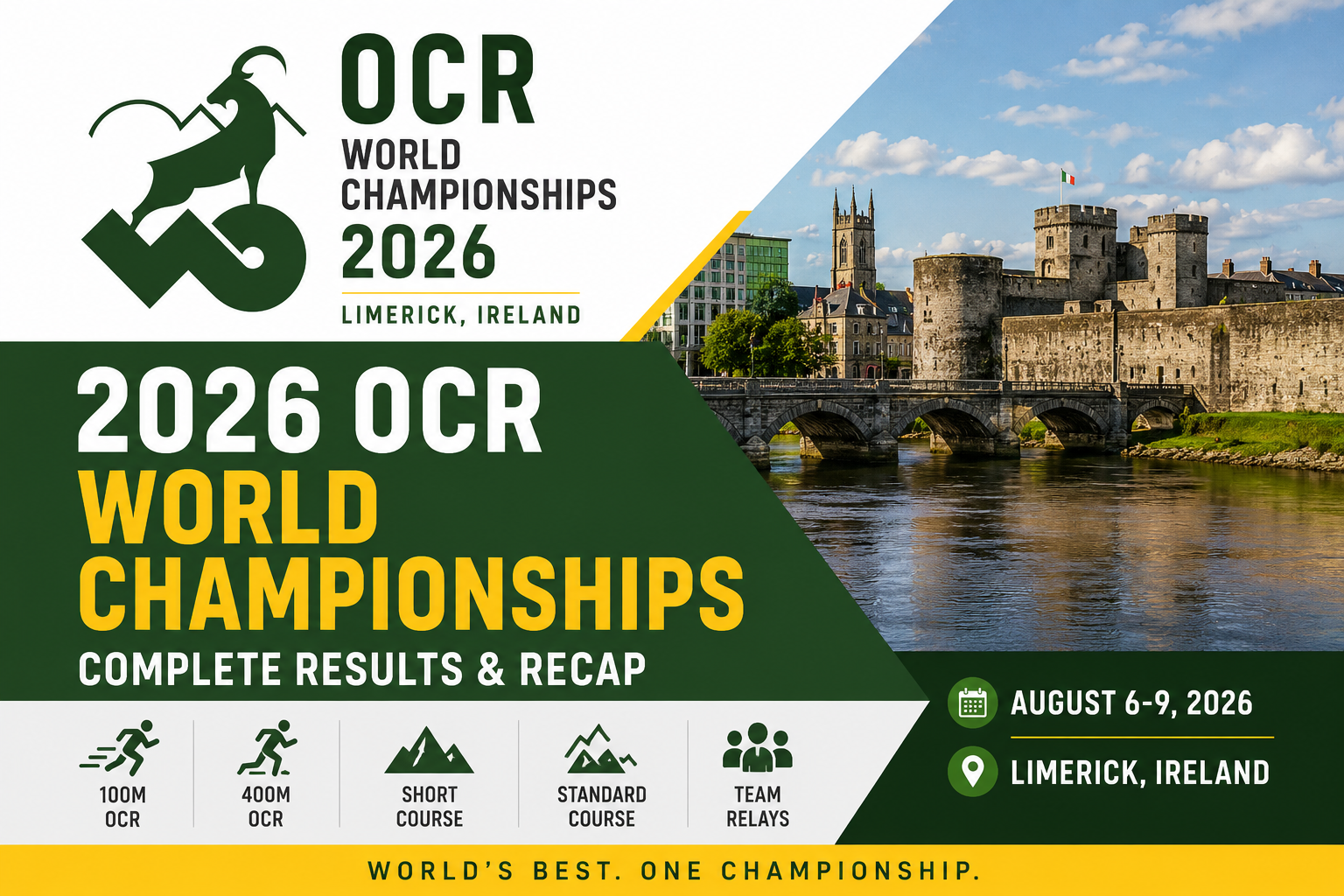
The 2026 OCR World Championships brought obstacle course racers from around the world to Limerick, Ireland, for four days of international competition from August 6-9, 2026.
Hosted at Limerick Racecourse, the championship program included the explosive 100-meter OCR, the championship debut of the 400-meter OCR, Short Course, Standard Course and multiple team relay formats. The official championship website lists the five primary disciplines as 100m, 400m, Short Course, Standard Course and Team Relay.
This year's event was particularly significant for the future of obstacle course racing. World Obstacle identifies the 2026 Limerick championship as the final OCR World Championships under World Obstacle/FISO governance as obstacle sport moves further into its integration with UIPM.
For athletes, coaches and OCR fans, here is our breakdown of what happened in Ireland, how the events worked, where to find every official result and what the championship tells us about modern obstacle-course racing.
RESULTS NOTE: The official timing database is still the authoritative source for individual placements, times, age-group standings, qualifying results and elimination-round results. Because the Race Result interface is dynamically generated and continues to be updated, Amped Obstacles is linking directly to that database rather than reproducing hundreds of athlete records that could subsequently be corrected or amended.
Official 2026 OCR World Championships Results Database
Where Were the 2026 OCR World Championships?
The World Championships took place at Limerick Racecourse in Limerick, Ireland, with the University of Limerick serving as the Athlete Village.
The competition ran from Thursday, August 6 through Sunday, August 9.
The championship schedule included:
100m OCR
400m OCR
Short Course
Standard Course
100m Team Relay
400m Team Relay
XC Team Relay
The official invitation scheduled the individual qualifying and championship races across the four-day program, culminating Sunday with XC Team Relay, the 100m and 400m semifinals/finals and the 100m and 400m team relays.
2026 OCR World Championships Results
The official results database separates the championships into a much deeper collection of results than simply listing one winner for each discipline.
For anyone looking for a particular athlete, country, age group or finishing time, these are the official result categories published for the event:
100M Results - Qualifying
100M Results - Elimination Rounds
100M Female Elite Bracket
100M Male Elite Bracket
100M Female Youth Bracket
100M Male Youth Bracket
100M Female Junior Bracket
100M Male Junior Bracket
100M Female Senior Bracket
100M Male Senior Bracket
100M Female Masters Bracket
100M Male Masters Bracket
100M Male Veteran Bracket
Teams 100M Relay
Short Course
Short Course Unranked
400m Qualifying
400m Round of 12
400m Round of 6
400m Finals
Standard Course
Standard Course Unranked
XC Team Relay
XC Team Relay Unranked
400m Teams
That distinction is important because there wasn't one single "OCR World Championship race."
Athletes were competing across very different tests of obstacle racing ability.
100m OCR World Championships
The 100m may be short, but calling it easy would completely misunderstand the event.
The official championship describes the 100m as a world-record-eligible obstacle course. Athletes received two runs, with the fastest competitors progressing from qualification into knockout rounds that ultimately determined the world champions.
This format places an enormous premium on efficiency.
There is very little time to recover from a bad transition.
A missed hand placement matters.
A hesitation matters.
A poor approach matters.
A fraction of a second matters.
It is obstacle racing stripped down to speed, precision and execution.
100m Qualifying Results
The first stage established which athletes would advance into elimination competition.
Because athletes received two opportunities on the championship course, qualification wasn't simply about surviving the obstacles. Athletes needed to produce a sufficiently fast completed run to advance.
The full qualifying standings, athlete times and progression information can be viewed through the official timing system:
2026 OCRWC Official 100m Results
100m Elimination Brackets
After qualification, the 100m shifted into head-to-head championship racing.
The official results separate those brackets into:
Female Elite
Male Elite
Female Youth
Male Youth
Female Junior
Male Junior
Female Senior
Male Senior
Female Masters
Male Masters
Male Veteran
This is one of the most interesting aspects of championship obstacle racing because athletes aren't simply competing against a clock anymore.
They're racing the athlete beside them.
A competitor can be incredibly fast in qualifying and still have to execute again when advancement is on the line.
100m Team Relay
The championship also took the sprint format and turned it into a national-team event.
The official 2026 championship information included a 100m Team Relay, with teams representing their nations. France's federation documentation confirms that the championship program included a 100m OCR Relay national-team format.
Relay racing introduces another layer to OCR.
Individual speed still matters, but now the result belongs to the team.
The 400m Made Its FISO World Championship Debut
One of the biggest developments of OCRWC 2026 was the arrival of the 400m Sprint OCR.
The championship officially described 2026 as the distance's debut at FISO OCR World Championship level.
That makes Limerick an important event in obstacle racing history.
The race was contested on a straight 400-meter grass course, with fully electronic timing from start to finish. Results and records were certified by the Event Technical Committee under the published competition procedures.
Why the 400m Is So Interesting
The 400m sits in a fascinating place between sprint OCR and traditional cross-country obstacle racing.
The 100m rewards extreme obstacle efficiency and speed.
Long-course OCR demands substantially greater endurance.
The 400m asks an athlete to repeatedly produce explosive obstacle movements while fatigue rapidly accumulates.
That creates a very different physiological and technical challenge.
Go too slowly and you're immediately behind.
Go too hard without the endurance to maintain obstacle execution and the course can punish you later.
400m Championship Format
The published results break the 400m competition into four stages:
400m Qualifying
↓
400m Round of 12
↓
400m Round of 6
↓
400m Finals
That progression made the event increasingly selective as the championship moved toward the final.
The official 400m page also confirms divisions for Elite, Age Group, Adaptive and Team Relay competition.
400m Team Competition
The championships didn't stop at individual 400m competition.
A 400m Team Relay was also included in the official championship program.
That gave countries another opportunity to combine individual obstacle ability into a national-team result.
For OCR fans, the expansion of both 100m and 400m relay racing is particularly interesting because these compact formats can make obstacle racing easier for spectators to follow than traditional long-course racing.
Short Course World Championships
Then the championship changed completely.
The Short Course moved away from the highly standardized sprint environment and into cross-country OCR.
World Obstacle's championship information describes the Limerick courses as combining technical obstacles with endurance elements at Limerick Racecourse.
The Short Course required athletes to combine running ability with obstacle proficiency across a substantially longer event than the 100m or 400m.
Slovakia's national OCR federation described the championship Short Course as approximately 3 km+ with 20+ obstacles.
This is where the definition of the "best obstacle athlete" becomes much more complicated.
What Makes Short-Course OCR Different?
An athlete can be incredible on obstacles and lose significant time running.
Another can be an exceptional runner but lose everything at a technical obstacle.
The strongest Short Course athletes have to combine both.
They need:
Running speed.
Obstacle efficiency.
Grip endurance.
Transitions.
Strength.
Coordination.
Technical confidence.
The ability to keep executing while their heart rate is elevated.
That's what makes competitive OCR so different from simply completing an obstacle course recreationally.
Short Course Ranked vs. Unranked Results
The official results include both:
Short Course
and
Short Course Unranked
That distinction matters when interpreting the finishing order.
The competitive championship standings and unranked results shouldn't automatically be treated as the same classification when reporting podiums.
Anyone researching a specific competitor should therefore verify the athlete's classification in the official database rather than simply looking at raw finish times.
Search the Official OCRWC 2026 Results
Standard Course World Championships
If the 100m is about explosive precision and the Short Course blends speed with obstacle proficiency, the Standard Course asks athletes to sustain performance much longer.
Slovakia's national OCR federation described the championship Standard Course format as approximately 12 km+ with 40+ obstacles.
That changes almost everything.
Athletes now have to manage effort across a long period.
Running economy matters.
Fueling and hydration become more important.
Grip fatigue accumulates.
Small inefficiencies compound.
A mistake early in the race doesn't necessarily end your championship, but repeatedly losing seconds or energy can become extremely expensive.
Standard Course Results
As with the Short Course, the official results distinguish:
Standard Course
and
Standard Course Unranked
The championship categories included Elite and qualified age-group competition, with qualification requirements determined through national federations. World Obstacle states that athletes competing in competitive categories had to qualify through their national federation.
This means an age-group world title isn't simply an open recreational race classification.
Athletes earned the opportunity to represent their countries at the championship level.
XC Team Relay
Sunday brought another major test: the XC Team Relay.
Team competition changes the psychology of obstacle racing.
An individual athlete can normally control their own pace and strategy.
In a relay, every athlete's performance contributes to the country's result.
The championship program officially scheduled XC Team Relay competition on Sunday before the final sprint championship rounds.
The official timing database again separates:
XC Team Relay
and
XC Team Relay Unranked
when presenting the results.
One Championship, Very Different Athletes
Perhaps the most interesting takeaway from Limerick is how broad obstacle course racing has become.
Consider the differences.
100m
Pure obstacle speed.
Fast transitions.
Explosive movement.
Minimal margin for error.
400m
Speed plus obstacle endurance.
Athletes need to remain technically efficient as fatigue builds rapidly.
Short Course
Running ability begins playing a substantially larger role while athletes still need world-class obstacle proficiency.
Standard Course
Endurance, pacing, obstacle proficiency and fatigue resistance become increasingly important.
Team Relays
Individual performance now has to contribute to a national-team outcome.
A world-class 100m specialist and a world-class Standard Course athlete can therefore look very different physically and train differently while competing within the same sport.
That is part of what makes OCR fascinating.
Why 2026 Was Historically Important for OCR
Limerick wasn't simply another World Championships.
It represented the end of an era.
UIPM reported after its 2025 Obstacle World Championships that the 2026 OCR World Championships in Limerick would be the final competition overseen by World Obstacle, as the organizations worked toward formal integration of obstacle sport within UIPM.
World Obstacle's updated championship page now similarly describes the 2026 event as the final OCR championships of its national federation members.
The official 2026 invitation even scheduled a historic handover ceremony from FISO to UIPM following the final competition.
For anyone following the development of obstacle sports, that makes the results from Ireland historically significant.
They represent the athletes and champions from a transitional moment in the sport.
OCR Is Becoming More Specialized
The results categories themselves reveal another major development.
Obstacle racing isn't simply "run several miles and complete obstacles" anymore.
The championship now included:
100 meters.
400 meters.
Short Course.
Standard Course.
Sprint relays.
400m relays.
Cross-country relays.
Elite divisions.
Age groups.
Youth divisions.
Adaptive competition.
Different athletes can specialize in completely different expressions of obstacle performance.
And that changes how OCR athletes should think about training.
What Can DFW OCR Athletes Learn From the World Championships?
You don't have to be competing for a world championship to learn something from the athletes in Limerick.
The biggest lesson is simple:
Obstacle racing requires more than one physical ability.
Running matters.
Strength matters.
Grip matters.
Technique matters.
Coordination matters.
Balance matters.
Power matters.
Endurance matters.
And the importance of each quality changes according to the race you're preparing for.
Someone training for a Spartan Race shouldn't necessarily train exactly like a 100m OCR athlete.
Someone preparing for Ninja Warrior shouldn't simply copy a Standard Course runner.
Someone preparing for a 400m obstacle race needs a different combination of speed, obstacle proficiency and conditioning.
Train for the demands of your event.
OCR Training in Dallas-Fort Worth
This is exactly why we believe obstacle athletes need access to actual obstacles.
You can build strength in a conventional gym.
You can develop aerobic capacity on a treadmill.
You can sprint on a field.
All of those things can be valuable.
But at some point, an obstacle athlete needs to touch obstacles.
You need to learn how your grip responds when your heart rate is elevated.
You need to understand swing mechanics.
You need to learn transitions.
You need to become comfortable moving your body through unfamiliar positions.
You need to figure out when brute strength works and when technique is faster.
And you need opportunities to fail an obstacle during training rather than discovering the weakness on race day.
Train OCR at Amped Obstacles in Grand Prairie, TX
For athletes in the Dallas-Fort Worth area, Amped Obstacles provides a dedicated environment for Ninja Warrior, obstacle-course and athletic training.
Whether you're training for your first obstacle race or preparing for higher-level competition, our Grand Prairie facility gives athletes an opportunity to actually practice obstacle movement.
Training can include challenges involving:
Grip strength
Hanging
Swinging
Climbing
Balance
Coordination
Obstacle transitions
Upper-body strength
Functional strength
Power
Agility
Conditioning
Obstacle efficiency
That doesn't mean every OCR athlete should train exactly the same way.
Quite the opposite.
The 2026 World Championships demonstrate why training should reflect the athlete and the event.
Training for a Spartan Race?
A Spartan athlete may need substantially more running and endurance work than someone preparing exclusively for a short Ninja course.
Obstacle sessions can complement that preparation by providing opportunities to develop grip, hanging, climbing and obstacle proficiency.
Training for Ninja Warrior?
Ninja training places a much greater emphasis on highly technical obstacles, grip, swinging, transitions, upper-body power, coordination and course strategy.
Running isn't normally the limiting factor in the same way it can be during cross-country OCR.
Training for Short-Course OCR?
Now both worlds collide.
You need to run.
You need to move quickly through obstacles.
You need enough grip and upper-body endurance to continue executing while fatigued.
And every slow transition costs time.
Training for 100m or 400m OCR?
Efficiency becomes everything.
The athlete has to move quickly without turning speed into chaos.
A transition that takes an extra second might not seem important during a recreational obstacle course.
At world-championship sprint level, it can be enormous.
Want to Become a Better Obstacle Athlete?
Start by getting on obstacles.
You don't have to be a world champion.
You don't even have to be preparing for a race.
You can be completely new.
At Amped Obstacles, beginners, recreational athletes, Ninja Warrior athletes, OCR competitors, Spartan racers and fitness enthusiasts can all find ways to challenge themselves.
The goal isn't for everyone to become the next OCR World Champion.
The goal is to find out what you're capable of.
Frequently Asked Questions About the 2026 OCR World Championships
When were the 2026 OCR World Championships?
The championships were held August 6-9, 2026 in Limerick, Ireland.
Where were the OCR World Championships held?
Competition was held at Limerick Racecourse, with the University of Limerick serving as the Athlete Village.
What events were contested?
The championship program included 100m, 400m, Short Course, Standard Course and team relay competition.
Was 400m OCR contested at the World Championships?
Yes. The official event organizers state that the 400m Sprint OCR made its FISO OCR World Championship debut in 2026.
How did the 100m OCR competition work?
Athletes received two runs on the world-record-eligible course, with the fastest competitors progressing from qualification into knockout competition.
Were there age-group world championships?
Yes. The championship structure included Elite, Age Group and Adaptive competition, depending on discipline. Competitive athletes qualified through their respective national federations.
Where can I find the complete OCR World Championships results?
The official timing database contains the complete published results across 100m qualifying and brackets, 400m rounds and finals, Short Course, Standard Course and team competition.
View the Official 2026 OCR World Championships Results
The Future of Obstacle Course Racing
The 2026 OCR World Championships showed just how much the sport has evolved.
OCR can now mean an explosive 100-meter sprint.
It can mean 400 meters of speed and obstacles.
It can mean several kilometers of running and technical challenges.
It can mean a long endurance course.
It can mean racing alone.
Or representing your country as part of a relay team.
And with the transition from World Obstacle/FISO toward UIPM governance, Limerick also represented a significant moment in the organizational history of international obstacle sports.
The sport continues to evolve.
The athletes continue to get faster.
The obstacles continue to become more technical.
And somewhere right now, the next generation of obstacle athletes is learning how to climb, swing, balance and conquer their first obstacle.
Ready to Start Training? Come Experience Amped Obstacles
Watching the OCR World Championships is exciting.
Getting on the obstacles yourself is even better.
If you're in Dallas-Fort Worth and want to experience Ninja Warrior or obstacle-course training, come train at Amped Obstacles in Grand Prairie, TX.
You don't need to be an elite OCR athlete.
You don't need to be preparing for a world championship.
You don't even need previous obstacle experience.
Beginners are welcome.
Kids can learn Ninja Warrior and obstacle skills through structured classes, while teens and adults can use obstacle and functional training to challenge strength, grip, balance, coordination, conditioning and overall athleticism.
Competitive athletes can also inquire about more focused Ninja Warrior, OCR and obstacle-course training.
Amped Obstacles
2626 Aero Dr.
Grand Prairie, TX 75052
From your first obstacle to your next competition, the only way to get better at obstacles is to start training.
Book your next class at Amped Obstacles and get on the course.
Official Sources
2026 OCR World Championships Official Website
Official 2026 OCRWC Results Database
World Obstacle OCR World Championships
AMPED OBSTACLES IS LOCATED IN GRAND PRAIRIE, TX

Relevant Articles:
What Classes Do You Have to Take for Early Childhood Development? (Grand Prairie, TX Guide)
Best After School Activities in Grand Prairie, TX (2026 Parent Guide)
Services at Amped Obstacles:
⭐️Ninja Warrior Classes (Kids, Teens, Adults)
⭐️Corporate/ Team Building Events
⭐️HYPERVOLT Percussion Massage Therapy & Recovery Sessions
⭐️Adult Obstacle Course Private Training
Location
2626 Aero Dr, Grand Prairie, TX 75052
We’re just minutes from major attractions and rapidly growing developments, including:
EpicCentral
Epic Waters Indoor Waterpark
The Epic Recreation Center
Bolder Adventure Park
Grand Prairie Premium Outlets
Topgolf Grand Prairie
The Landing by Tiffany Derry
Asia Times Square
This puts Amped Obstacles right alongside some of the most popular destinations families are already visiting, making it a perfect stop for a full day of fun and activity.
