The Ultimate Functional Fitness & Athletic Training Gym for Teens Ages 13–18 in Grand Prairie, TX
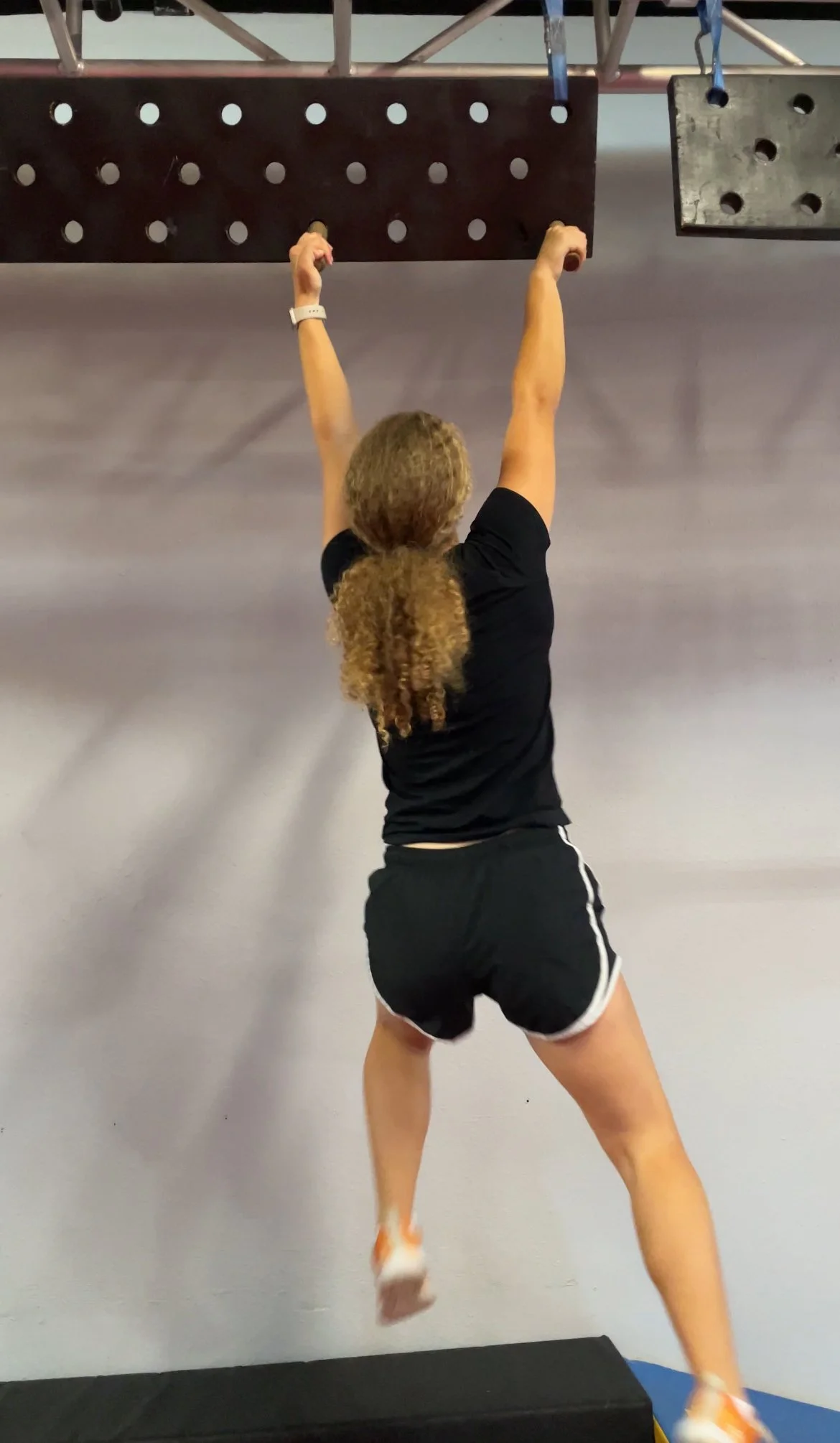
Finding the right gym for a teenager isn't always easy.
They're too old for many kids' fitness programs, but putting a 13-year-old into a traditional adult gym doesn't necessarily provide the coaching, movement development or training environment they need.
That's exactly where Amped Obstacles in Grand Prairie, TX comes in.
For teenagers ages 13-18, Amped offers something different from a conventional gym. Our obstacle-based environment gives teens an opportunity to work on strength, power, agility, balance, coordination, conditioning, grip strength and overall athleticism while learning how to better control and move their bodies.
You don't have to be a Ninja Warrior athlete.
You don't even have to play a sport.
If you're a teenager who wants to get stronger, become more athletic, improve your fitness and challenge yourself, there's a place for you at Amped.
Functional Fitness for Teens in Grand Prairie, TX
Functional fitness is ultimately about becoming more physically capable.
At Amped, that means teens aren't limited to sitting on machines and performing the same repetitive exercises every workout.
They can run.
Jump.
Climb.
Hang.
Swing.
Carry.
Push.
Pull.
Balance.
Accelerate.
Decelerate.
Change direction.
Control their own body weight.
Combine several of those abilities while navigating an obstacle.
These movements can challenge multiple components of fitness simultaneously and give teenagers opportunities to develop physical skills that extend beyond simply becoming better at one particular exercise.
For athletes, those qualities can complement sports performance.
For non-athletes, they can help build a stronger foundation of physical fitness and movement ability.
Amped is about developing capable teenagers, not just completing workouts.
More Than a Traditional Teen Gym
Walk into many conventional gyms and you'll find rows of treadmills, stationary bikes and strength machines.
Those tools can absolutely have a place in fitness.
But they're not the only way to train.
Amped Obstacles gives teenagers an entirely different environment.
Our facility is built around movement and physical challenges.
Instead of only asking, "How much can you lift?" we can challenge teenagers in different ways:
Can you control your own body weight?
Can you maintain your grip?
Can you generate enough power to reach the next obstacle?
Can you stabilize yourself on an unstable challenge?
Can you coordinate your upper and lower body?
Can you land under control?
Can you keep moving when you're tired?
Can you figure out a new movement?
That is what makes obstacle-based functional fitness so interesting.
Strength matters.
But so do coordination, power, balance, agility, endurance and body control.
Why Ages 13 to 18 Are So Important for Athletic Development
The teenage years represent an important period of physical development.
However, teenagers shouldn't simply be treated as smaller adults.
Adolescents can differ substantially in biological maturation, coordination, strength, training experience and physical development, even when they're the exact same chronological age.
That's one reason youth training should be appropriately coached and progressed.
A 13-year-old beginner and an experienced 17-year-old athlete shouldn't automatically receive identical training simply because they're both teenagers.
At Amped, the objective is to meet athletes and participants where they currently are and progressively challenge them.
What Can Teenagers Develop at Amped Obstacles?
Our training environment can challenge a wide range of physical abilities.
Strength
Strength provides a foundation for many other athletic qualities.
At Amped, teenagers can encounter bodyweight and resistance-based challenges involving pushing, pulling, carrying, climbing, hanging and stabilizing.
Developing strength isn't about turning every teenager into a bodybuilder.
It's about becoming physically stronger and more capable.
Power
Sports and everyday athletic movement frequently require force to be produced quickly.
Jumping, sprinting, accelerating and explosive obstacle movements can all challenge an athlete's ability to generate power.
Agility
Athletes rarely move in perfectly straight lines at one constant speed.
They accelerate, slow down, reposition themselves and change direction.
Agility and movement training can help teenagers develop the physical tools needed to move efficiently through dynamic environments.
Balance
Balance challenges force athletes to control their center of mass while navigating different positions and surfaces.
This can be particularly valuable because balance requires both physical ability and concentration.
Coordination
Strength alone doesn't make someone athletic.
The body also has to coordinate movements efficiently.
Obstacle training frequently requires athletes to combine their hands, feet, eyes, trunk and momentum to successfully complete a task.
Grip Strength
Hanging and climbing are fundamental components of obstacle training.
Monkey bars, rigs and hanging obstacles can challenge grip and pulling strength in ways that many teenagers rarely encounter elsewhere.
Conditioning
Sometimes the challenge isn't completing one obstacle.
It's completing the next one when you're already tired.
Structured circuits and continuous movement can challenge cardiovascular fitness and muscular endurance while keeping training engaging.
Body Control
Can you control your body while hanging?
Can you stabilize yourself after jumping?
Can you maintain position while moving across an obstacle?
Can you produce force without losing control?
Developing strength relative to your own body can be an important part of becoming a more capable mover.
Strength Training for Teenagers Is Not Something to Fear
One persistent fitness myth is that teenagers should avoid strength or resistance training because it will "stunt their growth."
Modern exercise science does not support a blanket prohibition on resistance training for adolescents.
Properly designed, appropriately progressed and supervised resistance training is widely recognized as an acceptable component of youth physical development.
The important words are properly designed, appropriately progressed and supervised.
Teen fitness should not be about chasing adult lifting numbers, using inappropriate loads or sacrificing technique to impress friends.
Good youth training prioritizes movement quality, appropriate progression and the individual athlete's developmental level and experience.
You Don't Have to Play Sports to Train Like an Athlete
This is one of the most important things we want teenagers and parents to understand about Amped.
Athletic training isn't only for athletes.
Maybe your teenager doesn't play football.
Maybe they didn't make the basketball team.
Maybe organized sports simply aren't their thing.
That doesn't mean they shouldn't have an opportunity to become strong, coordinated, conditioned and confident in their physical abilities.
Some teenagers love traditional team sports.
Others don't.
Some would much rather conquer an obstacle, climb, race through a course or improve a physical skill than spend an hour on a treadmill.
That's okay.
Fitness should have room for them too.
At Amped Obstacles, a teenager can pursue athleticism itself.
Already Play Sports? Build the Athlete Behind the Sport.
For competitive athletes, Amped can serve a different purpose.
Your team practices your sport.
You come to Amped to work on the athlete underneath the uniform.
That can include qualities such as strength, power, coordination, agility, balance, conditioning and body control.
Those qualities are relevant across numerous sports.
Amped can provide supplemental athletic training for teenagers participating in:
Football
Basketball
Soccer
Baseball
Softball
Volleyball
Wrestling
Track and field
Cross country
Tennis
Lacrosse
Swimming
Cheer
Dance
Gymnastics
Martial arts
Ninja Warrior
Obstacle course racing
Other competitive and recreational sports
The goal isn't to replace your sport coach.
If you're a baseball player, you still need baseball practice.
If you're a basketball player, you still need to work on basketball.
If you're a soccer player, you still need technical soccer training.
Amped develops physical qualities that can complement the work you're already doing.
A Gym for Teenagers Who Don't Like Traditional Gyms
There's another teenager we built this experience for.
The teenager who says:
"The gym is boring."
Traditional exercise doesn't connect with everyone.
Walking on a treadmill while staring at a screen isn't necessarily going to excite a 14-year-old.
Neither is sitting on machine after machine counting repetitions.
At Amped, training can feel different because there's often a problem to solve.
How do I get across this obstacle?
How do I generate more momentum?
Where should my feet go?
How can I improve my grip?
Can I beat my previous attempt?
Can I make it through the entire course?
That turns exercise into a challenge.
You're still working.
You're still developing fitness.
But now there's something to accomplish.
Training That Can Grow With You
Beginners don't need to walk through our doors already strong.
That's the point of training.
A teenager may initially struggle to hang from an obstacle.
Then they hang longer.
Eventually they start moving across it.
Then they complete it.
Then they begin working on something harder.
Progress doesn't have to mean adding another plate to a barbell.
Progress can mean:
One more repetition.
A stronger grip.
A longer hang.
A higher jump.
Better balance.
More controlled movement.
Completing an obstacle that used to stop you.
Finishing a circuit faster.
Recovering more quickly between efforts.
Those improvements give teenagers tangible ways to recognize that their work is producing results.
Functional Fitness for High School Athletes
For high school athletes, supplemental functional and athletic training can be useful during both the competitive season and off-season when appropriately programmed around the athlete's total workload.
The off-season can provide an opportunity to emphasize athletic development and prepare physically for the next season.
In-season training may require a different approach because practices, games and competitions already contribute substantial physical stress.
More training is not automatically better training.
Athletes should consider their complete workload, recovery and sport schedule rather than treating every workout as an isolated event.
Teen Fitness Should Develop More Than One Physical Quality
One of the concepts supported by long-term athletic development research is the importance of developing a broad foundation of physical abilities.
That's something obstacle training naturally encourages.
An obstacle course doesn't care that you're great at one particular exercise.
You may need strength for one challenge.
Balance for the next.
Power after that.
Then grip.
Then coordination.
Then conditioning.
This variety is one reason Amped can be such an interesting environment for teenagers.
We're not asking every teenager to become the same type of athlete.
We're creating opportunities for them to become more complete movers.
What About Teenagers Who Are Beginners?
Beginners are welcome.
Your teenager does not need to:
Play varsity sports
Be able to do pull-ups
Know how to climb
Have previous Ninja Warrior experience
Be exceptionally strong
Be exceptionally fast
Already consider themselves "athletic"
Everyone has a starting point.
The objective is to build from there.
A teenager who is new to fitness may need different progressions than an experienced high school athlete, and that's exactly how training should work.
What Makes Amped Obstacles Different?
Amped isn't trying to be another giant commercial gym.
We're an obstacle and athletic training facility built around movement, challenge, coaching and community.
Our environment gives teenagers access to physical challenges that are difficult to recreate in a conventional fitness center.
That includes climbing and hanging challenges, balance obstacles, obstacle-course movements, bodyweight exercises and opportunities to combine strength and conditioning with movement skills.
It creates a simple question for teenagers every time they train:
What can I do today that I couldn't do before?
That's a powerful way to approach fitness.
Teen Fitness Classes and Athletic Training in Grand Prairie, TX
Amped Obstacles is located in Grand Prairie, Texas, making us accessible to families throughout the central Dallas-Fort Worth area.
We welcome teens from Grand Prairie and surrounding communities, including Arlington, Mansfield, Irving, Cedar Hill, Dallas and other DFW cities.
Whether your teenager is a competitive high school athlete, recreational athlete, Ninja Warrior competitor or simply needs a physical activity they can actually enjoy, Amped provides another option.
Frequently Asked Questions
What ages are teen training at Amped designed for?
This article specifically focuses on teenagers ages 13–18. Amped also offers other programs for younger participants and adults.
Does my teenager need to be an athlete?
No. Teenagers do not need to participate in an organized sport to train at Amped.
Is Amped a teen strength and conditioning gym?
Strength and conditioning are components of athletic development, but Amped's environment goes beyond conventional strength training. Obstacles can also challenge coordination, balance, agility, grip, power, movement skills and conditioning.
Can high school athletes train at Amped?
Yes. Amped can provide an additional training environment for high school athletes who want to develop general physical qualities alongside their sport-specific training.
Can beginners participate?
Yes. Teenagers don't need previous Ninja Warrior or obstacle-training experience to get started.
Is obstacle training only useful for Ninja Warrior competitors?
No. Obstacles are the training environment, but many of the underlying physical qualities being challenged, including strength, power, coordination, balance, grip and conditioning, are broader components of physical fitness and athleticism.
Where is Amped Obstacles?
Amped Obstacles is located at:
2626 Aero Dr.
Grand Prairie, TX 75052
Find a Better Way for Your Teen to Train
Teenagers need opportunities to move.
They need opportunities to become stronger.
They need challenges.
They need an environment where physical improvement doesn't have to mean standing in front of a mirror performing the same workout over and over again.
That's what we're building at Amped Obstacles.
For ages 13–18, Amped can be a place to develop strength, improve conditioning, challenge coordination, build athleticism, learn new movement skills and discover what your body is capable of doing.
Competitive athlete?
Come train.
Getting ready for high school sports?
Come train.
Ninja athlete?
Come train.
Never played a sport in your life but want to get stronger and fitter?
Come train.
Ready to Get Started?
Contact Amped Obstacles in Grand Prairie, TX to learn about training options for your teenager.
Tell us their age, current activity or sport, training experience and goals, and we'll help determine the best place to start.
Amped Obstacles
2626 Aero Dr.
Grand Prairie, TX 75052
Functional fitness. Strength. Athleticism. Obstacles. One place to train.
Scientific References
The scientific foundation for this article comes from peer-reviewed research and professional consensus literature on adolescent resistance training, physical performance and long-term athletic development.
Harries, Lubans & Callister, Journal of Science and Medicine in Sport: A systematic review and meta-analysis found evidence that resistance-training interventions can improve muscular power in adolescent athletes, including improvements in measures such as vertical-jump performance.
Lesinski, Prieske & Granacher, British Journal of Sports Medicine: This systematic review and meta-analysis of youth athletes found resistance training produced improvements in strength and jump performance, with smaller positive effects observed for sprinting, agility and sport-specific performance.
Behm et al., Sports Medicine: An umbrella review synthesizing 14 meta-analyses found youth resistance training produced improvements across several physical-fitness outcomes, including muscular strength and power, with evidence of improvements in sprinting, agility/change-of-direction and other performance measures. The authors also noted limitations in the quality of the underlying evidence.
Lloyd et al., British Journal of Sports Medicine: International consensus literature on youth resistance training supports appropriately prescribed resistance training for young people and emphasizes developmentally appropriate practice.
Faigenbaum et al., Journal of Strength and Conditioning Research: The National Strength and Conditioning Association's position statement concluded that properly designed and supervised youth resistance training can improve strength and power and can contribute to motor-skill and physical-fitness development.
Proud to Train the Next Generation of Grand Prairie
Amped Obstacles is proud to call Grand Prairie, Texas home.
Grand Prairie's history stretches back more than 160 years. The community that would eventually become Grand Prairie began taking shape in 1863, when Alexander MacRae Dechman filed title to 239.5 acres in what is now downtown Grand Prairie. The growing community became known as Grand Prairie in 1877 and was later officially incorporated as a city in 1909.
Today, Grand Prairie sits at the heart of the Dallas-Fort Worth area and is home to generations of young athletes, students and families.
At Amped Obstacles, we're proud to be part of that community and to provide a local place where the next generation of Grand Prairie teens can train, move, get stronger and develop their athletic abilities.
For families searching for teen fitness, functional fitness, strength and conditioning, obstacle training or athletic training in Grand Prairie, TX, Amped Obstacles is right here in your community.
Amped Obstacles
2626 Aero Dr.
Grand Prairie, TX 75052
