How Can My Kid Get Faster for Sports? A Grand Prairie, TX Guide to Youth Speed & Athletic Performance Training

How Can My Kid Get Faster for Sports?
It's one of the most common questions parents of young athletes ask:
“How can my kid get faster?”
Maybe your child plays soccer and struggles to beat defenders to the ball.
Maybe they're playing football and need a quicker first few steps.
Maybe they're trying to steal bases in baseball or softball.
Maybe they play volleyball or basketball and need to move faster around the court.
Or maybe they're preparing for middle school, high school, club or select sports and simply want to become a better overall athlete.
Parents often assume the answer is straightforward:
Run more.
But developing speed is more complicated than simply making a young athlete run until they're tired.
Research on youth athletes indicates that sprint performance can respond to several forms of appropriately designed training, including sprinting, resistance training and plyometric training. Recent systematic reviews and meta-analyses have reported improvements in sprint performance among children and adolescents following structured plyometric and strength-based interventions.
If you're searching for kids sports training in Grand Prairie, TX, here's what parents should understand about helping a young athlete become faster.
First: What Does “Faster” Actually Mean?
When a parent says, “I want my child to get faster,” we first need to understand what their sport requires.
A 100-meter sprinter needs speed.
But so does a shortstop.
So does a wide receiver.
So does a soccer player.
The difference is that these athletes don't use speed in exactly the same way.
In many youth team sports, the athlete frequently needs to accelerate quickly over a short distance rather than simply reach the highest possible top speed.
Think about a basketball player exploding toward a loose ball.
A softball player leaving first base.
A football player accelerating off the line.
A soccer player attacking open space.
Those first few steps can matter enormously.
Then there's another ability entirely:
Changing direction quickly.
A child might be fast running straight ahead but struggle to decelerate, plant and accelerate in another direction.
That's why effective sports performance training should go beyond simply asking:
“How fast can you run?”
We also want to develop the physical qualities that contribute to athletic movement.
1. Kids Need to Practice Sprinting to Get Better at Sprinting
This sounds obvious, but it gets overlooked.
If you want to improve a skill, you generally need opportunities to practice that skill.
Speed training shouldn't always mean conditioning.
There is an important difference between:
running fast
and
running until you're exhausted.
If the goal of a training segment is maximum acceleration or sprint quality, athletes generally need enough recovery to produce high-quality efforts rather than turning every sprint session into endurance training.
A youth athlete may practice:
Short accelerations.
Different starting positions.
Reaction starts.
Short-distance sprints.
Technique-focused running drills.
Progressively longer sprint efforts when appropriate.
The exact training should depend on the athlete's age, experience, sport and needs.
The exact training should depend on the athlete's age, experience, sport and needs.
2. Getting Stronger Can Help Young Athletes Become Faster
Parents sometimes separate strength and speed as though they're completely unrelated.
They aren't.
Running requires athletes to apply force against the ground.
Appropriately programmed resistance training can improve physical performance in youth athletes.
A systematic review and meta-analysis of youth athletes ages 6-18 found resistance training produced improvements in muscular strength and jumping performance and smaller positive effects on linear sprint, agility and sport-specific performance.
A more recent meta-analysis of male adolescent team-sport athletes found both strength and plyometric training improved acceleration, linear sprint and change-of-direction performance, although the magnitude of the effects differed between training methods and outcomes.
That doesn't mean your 10-year-old needs to train like a professional powerlifter.
It means appropriately designed strength training can be part of youth athletic development.
What Does Strength Training for Kids Look Like?
Depending on age and experience, training might include exercises such as:
Squats and squat variations
Lunges and split squats
Hip-hinge movements
Step-ups
Push-ups
Rows and pulling movements
Carries
Core exercises
Bodyweight movements
Appropriately loaded resistance exercises
The objective is not to see how much weight a child can lift.
Technique comes first.
Progression comes later.
The National Strength and Conditioning Association's position statement on youth resistance training supports appropriately designed and supervised resistance exercise for children and adolescents and emphasizes qualified instruction, appropriate progression and program design.
3. Jumping Can Be Part of Speed Development
Jumping isn't just for basketball and volleyball players.
Plyometric exercises use rapid stretch-shortening actions and can be incorporated into athletic development when they're appropriate for the athlete.
Examples might include:
Pogo jumps.
Vertical jumps.
Broad jumps.
Lateral jumps.
Bounds.
Hops.
Low-level reactive jumping.
More advanced variations as an athlete develops.
Why would jumping help a child run faster?
Because sprinting and jumping both involve the ability to produce force rapidly.
And the research is increasingly strong here.
A 2026 systematic review and meta-analysis encompassing 63 studies of healthy adolescents ages 10-19 found that plyometric training improved jump, sprint and agility performance. The authors also reported that benefits appeared more consistent with interventions lasting at least 10 weeks, although they cautioned that study heterogeneity limits some subgroup conclusions.
Another 2026 meta-analysis involving 1,033 adolescent team-sport athletes similarly found improvements in jumping, linear sprinting and change-of-direction performance following plyometric training.
The important takeaway isn't:
“Make your kid do hundreds of jumps.”
It's that properly programmed explosive training can be one component of developing athletic performance.
4. Acceleration Matters
For many young athletes, getting faster isn't primarily about maximum velocity.
It's about getting somewhere first.
Imagine a softball player trying to beat a throw to first.
The distance is short.
A football player breaks toward an opening.
Short distance.
A basketball player reacts to a turnover.
Short distance.
A soccer player races toward a loose ball.
Again, often a short distance.
That makes acceleration extremely important.
Training can include short sprints where athletes focus on producing powerful, coordinated first steps rather than simply running long distances.
Recent research in adolescent team-sport athletes has found both plyometric and strength training capable of improving measures of short acceleration, although training response varies among athletes and programs.
5. Don't Confuse Speed Training With Conditioning
This deserves its own section.
Making your child exhausted does not automatically make them faster.
A coach can set up 30 minutes of nonstop cones, sprints, burpees and ladders.
Your child will sweat.
They'll breathe hard.
They'll be tired.
It might be conditioning.
But fatigue itself isn't proof that the session developed maximum speed.
When the goal is high-quality sprint performance, repeatedly asking an exhausted athlete to move “as fast as possible” can undermine the quality of those efforts.
A hard workout and an effective speed-development session aren't necessarily the same thing.
There is a place for conditioning.
There is also a place for speed.
Good sports performance training understands the difference.
6. Change of Direction Is Different From Straight-Line Speed
Sports don't happen exclusively in straight lines.
A soccer defender reacts.
A basketball player cuts.
A football player changes direction.
A softball player moves laterally to field a ball.
An athlete needs to control their body as they slow down, reposition and accelerate again.
That's why athletic performance programs often incorporate change-of-direction training alongside sprinting.
A 2026 meta-analysis found resisted training methods produced improvements in change-of-direction performance, with adolescent participants showing meaningful improvements in the pooled analysis.
Plyometric training has also repeatedly demonstrated positive effects on change-of-direction performance in adolescent athletes.
7. Teach Kids How to Decelerate Too
Everybody wants their athlete to accelerate.
But sports also require athletes to stop.
A player might sprint forward and suddenly need to change direction.
That means the body has to absorb force, control momentum and reposition itself before accelerating again.
Training should therefore expose athletes to appropriate landing, stopping and movement-control tasks rather than focusing exclusively on how quickly they can start.
This is another reason broader athletic development matters.
The goal isn't simply to create a child who can run fast in a straight line.
It's to develop an athlete who can move well in multiple situations.
8. Coordination Matters More Than Parents Sometimes Realize
Watch young athletes run and you'll notice enormous differences.
Some look smooth and coordinated.
Others look like they're fighting their own bodies.
Youth athletes are still developing movement skills.
Running mechanics involve coordinated actions throughout the body. That's one reason young athletes benefit from opportunities to develop a broad movement foundation rather than immediately specializing every training session around one narrow skill.
Obstacle training can add another dimension here.
An obstacle may ask an athlete to:
Run.
Jump.
Reach.
Catch.
Swing.
Balance.
Land.
Change direction.
Coordinate the upper and lower body.
Solve a movement problem.
The objective isn't necessarily to make obstacle training replace sprint training.
It can complement broader athletic development.
9. Kids Need Power, Not Just Strength
Strength and power aren't exactly the same thing.
Strength generally relates to an athlete's ability to produce force.
Power incorporates how quickly force can be produced.
Sports frequently happen quickly.
Jumping for a volleyball.
Exploding off the line in football.
Accelerating toward the soccer ball.
Taking off for second base.
Those movements don't give athletes unlimited time to generate force.
Plyometric training is particularly relevant here because research in adolescent athletes has repeatedly found improvements in jumping and explosive performance.
10. Don't Forget Recovery
More training isn't automatically better training.
This is especially important for kids who already participate in multiple sports.
Consider a teenager who has:
School practice.
Club practice.
Weekend tournaments.
Strength training.
Speed training.
Private coaching.
Games.
PE.
Then parents add another three workouts because they want them to get faster.
At some point, additional training can simply become additional fatigue.
Athletic development needs to account for the athlete's total workload, not just what happens during one training session.
How Long Does It Take for a Kid to Get Faster?
Parents naturally want a timeline.
Unfortunately, there isn't one universal answer.
It depends on:
The child's age.
Biological maturation.
Training history.
Current strength.
Sprint mechanics.
Sport.
Training frequency.
Training quality.
Recovery.
Consistency.
And where they're starting.
Scientific studies often examine training blocks lasting multiple weeks rather than expecting meaningful athletic development after a handful of workouts.
For example, recent reviews of adolescent plyometric training have reported improvements across programs lasting several weeks, with some analyses finding more consistent benefits in longer interventions.
That's an important lesson for parents:
Athletic development is a process.
Don't expect one speed camp to completely transform an athlete.
Can Girls Get Faster Through Sports Performance Training?
Absolutely.
Speed, strength and power development aren't only for boys.
A systematic review and meta-analysis specifically examining female adolescent team-sport athletes found both strength and plyometric training improved measures of vertical jump, linear sprint and change-of-direction speed.
Girls playing:
Softball.
Volleyball.
Soccer.
Basketball.
Track.
Flag football.
Lacrosse.
Tennis.
Or other sports can all have reasons to develop speed and general athleticism.
The program should be appropriate for the individual athlete.
How Can My Soccer Player Get Faster?
Soccer players repeatedly accelerate, decelerate and change direction.
That makes speed development particularly relevant.
A 2025 systematic review and meta-analysis involving 796 adolescent soccer players found plyometric training improved jumping, sprinting and change-of-direction performance compared with soccer training alone.
That doesn't mean soccer players should stop practicing soccer.
It means appropriate physical preparation can complement sport-specific practice.
How Can My Football Player Get Faster?
Football often rewards short acceleration, explosive power and the ability to change direction.
Training may therefore incorporate:
Short sprints.
Acceleration drills.
Strength training.
Jump training.
Change-of-direction work.
Reaction exercises.
Position-specific practice remains the responsibility of football coaching.
Sports performance training develops the physical athlete underneath those football skills.
How Can My Baseball or Softball Player Get Faster?
Baseball and softball repeatedly require short bursts of movement.
Think:
Getting out of the batter's box.
Stealing a base.
Running down a ball.
Changing direction in the field.
Speed development for these athletes can therefore emphasize short acceleration, strength, power and movement quality alongside their baseball or softball skill development.
How Can My Basketball Player Get Faster?
Basketball combines acceleration, stopping, lateral movement, jumping and repeated changes of direction.
Straight-line sprinting can be useful, but it isn't the entire picture.
An athletic-development program can complement basketball practice by developing physical qualities such as:
Strength.
Acceleration.
Power.
Jumping ability.
Change of direction.
Coordination.
Movement control.
How Can My Volleyball Player Get Faster?
Volleyball doesn't involve long-distance sprinting, but athletes still need to react and move quickly.
A volleyball player may need to take a few explosive steps, change direction, jump and recover rapidly for the next play.
That makes lower-body strength, explosive power, coordination and short-distance movement particularly relevant.
What About Kids Who Aren't Naturally Fast?
This is where parents need to be careful with labels.
Try not to tell a young athlete:
“You're just slow.”
Children develop at different rates.
Maturation differs.
Training histories differ.
Movement experience differs.
And several physical qualities related to sports performance are trainable.
Research shows that structured training can improve sprint, strength, jump and change-of-direction performance in youth populations.
Not every child will become the fastest athlete on their team.
That's not a reasonable promise for any coach to make.
But athletes can work toward becoming stronger, more coordinated, more powerful and faster versions of themselves.
Should My Child Use a Speed Ladder?
Speed ladders can be useful for certain coordination and footwork activities.
But parents shouldn't mistake moving the feet quickly through a ladder for automatically developing maximum sprint speed.
If the objective is to run faster, actual sprinting and the physical qualities underlying sprint performance need attention.
Ladders can be a tool.
They aren't a complete speed-development program.
Should Kids Run With Parachutes or Sleds?
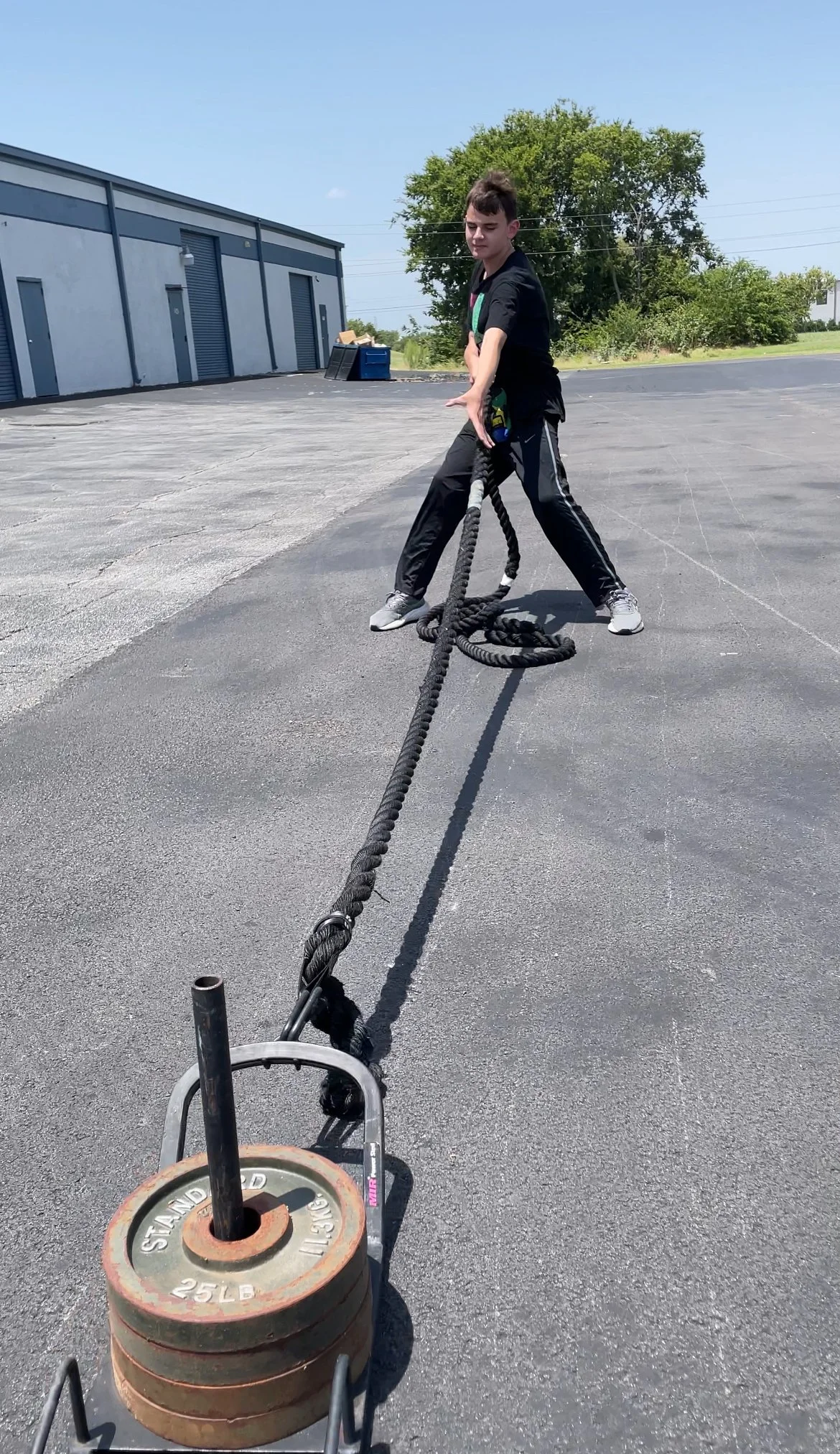
Resisted sprinting can be useful when programmed appropriately.
A 2025 systematic review and meta-analysis found resisted sprint training improved sprint performance and also reported improvements in jump and change-of-direction measures across the athletes studied.
But adding resistance doesn't automatically make an exercise better.
Loading, technique and the athlete's training experience matter.
This is another reason youth athletes benefit from qualified coaching instead of simply copying whatever drill appears on social media.
What Should Parents Look for in Kids Sports Training?
If you're looking for kids sports training in Grand Prairie, TX, don't judge a program by how exhausted your child looks afterward.
Look deeper.
Does the coach teach technique?
Does training match the athlete's age?
Are exercises progressed rather than randomly changed?
Does the coach understand the difference between speed and conditioning?
Does the athlete practice actual acceleration?
Is strength included appropriately?
Are jumping and landing skills taught?
Does the program develop multiple athletic abilities?
Is the athlete supervised?
Is your child engaged?
And perhaps most importantly:
Is there a reason behind what they're doing?

Kids Sports Training in Grand Prairie, TX at Amped Obstacles
This is where Athletic Sports Performance Coaching at Amped Obstacles comes in.
Amped Obstacles - Grand Prairie provides an environment where young athletes can work on broader athletic development alongside the unique movement challenges of an actual obstacle-course facility.
Our goal isn't to replace your child's sports coach.
We build the athlete behind the sport.
Your child's baseball coach should teach baseball.
Their soccer coach should teach soccer.
Their volleyball coach should teach volleyball.
Their football coach should teach football.
Athletic performance training can complement that coaching by developing physical qualities that athletes use across sports.
What Can Athletic Performance Training at Amped Work On?
Depending on the athlete's age, experience and goals, training can incorporate development of:
Acceleration
Learning to produce effective first steps and accelerate over short distances.
Speed
Practicing high-quality sprinting rather than treating every run as conditioning.
Strength
Developing the physical foundation required to produce and control force.
Power
Learning to express force quickly through appropriate jumping and explosive movements.
Agility & Change of Direction
Learning to control the body while stopping, repositioning and accelerating.
Balance
Controlling body position in stable and unstable movement situations.
Coordination
Developing efficient whole-body movement.
Reaction
Responding to external cues rather than simply memorizing every drill.
Body Control
Learning how to accelerate, jump, land, balance and move with greater control.
Obstacle Skills
Using climbing, hanging, swinging, jumping and obstacle challenges to expose athletes to movement problems they may not encounter in conventional sports practice.
Why Train Athletes on an Obstacle Course?
This is one of the things that makes Amped different from a conventional sports-performance environment.
We can train traditional athletic qualities.
But we also have obstacles.
An athlete might need to accelerate toward a challenge, jump, control a landing, balance, climb, swing or coordinate several movements in sequence.
That doesn't mean obstacle training magically makes someone faster.
It doesn't.
Speed still needs to be trained.
Strength still needs to be developed.
Sport skills still need to be practiced.
But obstacle training can provide a challenging environment for developing broader movement competency, coordination, strength, grip, balance and problem-solving.
For young athletes, that variety can also make training more engaging.
One Athlete. Multiple Sports.
Athletic performance training at Amped can be relevant to young athletes participating in:
Football
Soccer
Basketball
Baseball
Softball
Volleyball
Track
Cross Country
Swimming
Tennis
Wrestling
Gymnastics
Cheer
Dance
Tumbling
Ninja Warrior
Obstacle Course Racing
And other youth sports.
The exercises may change.
The athlete's needs may change.
But qualities such as strength, speed, coordination and power appear across a wide range of sports.
Frequently Asked Questions About Kids Speed Training
What age should kids start speed training?
There isn't one universal age at which all children should begin a formal speed program. Training should match the child's developmental level, movement competency and ability to follow instruction. Youth resistance and plyometric training research supports age-appropriate, properly supervised training rather than using a one-size-fits-all chronological age cutoff.
Can strength training make kids faster?
It can contribute. Meta-analytic evidence in youth athletes has found resistance training can improve strength and other performance measures, including smaller improvements in sprint and agility performance.
Do plyometrics make kids faster?
Research suggests appropriately programmed plyometric training can improve sprint performance in children and adolescents, although effect sizes, study quality and individual responses vary.
Is speed training useful if my child already practices their sport?
Potentially. Sport practice develops sport-specific skills, while supplemental athletic training can target physical qualities such as strength, acceleration and power. The appropriate amount depends on the athlete's existing practice and competition workload.
Where can I find kids sports training in Grand Prairie, TX?
Amped Obstacles offers Athletic Sports Performance Coaching in Grand Prairie for families looking for individualized athletic development beyond regular sport practice.
Want Your Kid to Get Faster? Start Building the Athlete.
There is no secret drill.
No magic ladder.
No exercise that suddenly makes every child fast.
And no responsible coach should promise that your child will become the fastest player on the team.
What we can do is train the qualities that contribute to athletic performance.
Sprint.
Get stronger.
Develop power.
Learn to jump and land.
Improve coordination.
Practice changing direction.
Move with purpose.
And do it consistently.
The scientific literature is clear enough to reject the idea that youth athleticism is completely fixed. Appropriately designed training can improve multiple physical-performance qualities in children and adolescents.
Book Athletic Sports Performance Coaching at Amped Obstacles
If you've been searching for kids sports training in Grand Prairie, TX, youth speed training, or athletic performance training for your child, we'd love to learn more about your athlete.
Tell us:
Their age.
Their sport.
What position they play.
What they're currently struggling with.
What they want to improve.
From there, we can determine whether Athletic Sports Performance Coaching at Amped is a good fit.
Amped Obstacles
2626 Aero Dr.
Grand Prairie, TX 75052
Don't wait until the week before tryouts to start working on speed.
Contact Amped Obstacles today to get your young athlete started with Athletic Sports Performance Coaching in Grand Prairie, TX.
Scientific Literature
All training and performance claims in this article were based on peer-reviewed scientific literature. No unsupported claim of guaranteed speed improvement is intended.
Yuan S, et al. The effects of plyometric training on adolescent sports performance: a systematic review and meta-analysis. PeerJ. 2026.
Zhang et al. The effects of plyometric training on physical fitness in adolescent team sports: a systematic review and meta-analysis. 2026.
Zheng T, et al. Effects of plyometric training on jump, sprint, and change of direction performance in adolescent soccer player: A systematic review with meta-analysis. PLOS ONE. 2025.
Lesinski M, et al. Effects and dose-response relationships of resistance training on physical performance in youth athletes: a systematic review and meta-analysis. British Journal of Sports Medicine. 2016.
Faigenbaum AD, et al. Youth resistance training: updated position statement paper from the National Strength and Conditioning Association. Journal of Strength and Conditioning Research. 2009.
Ramirez-Campillo R, et al. Plyometric-Jump Training Effects on Physical Fitness and Sport-Specific Performance According to Maturity: A Systematic Review with Meta-analysis. Sports Medicine - Open. 2023.

Relevant Articles:
What Classes Do You Have to Take for Early Childhood Development? (Grand Prairie, TX Guide)
Best After School Activities in Grand Prairie, TX (2026 Parent Guide)
Services at Amped Obstacles:
⭐️Ninja Warrior Classes (Kids, Teens, Adults)
⭐️Corporate/ Team Building Events
⭐️HYPERVOLT Percussion Massage Therapy & Recovery Sessions
⭐️Adult Obstacle Course Private Training
Location
2626 Aero Dr, Grand Prairie, TX 75052
We’re just minutes from major attractions and rapidly growing developments, including:
EpicCentral
Epic Waters Indoor Waterpark
The Epic Recreation Center
Bolder Adventure Park
Grand Prairie Premium Outlets
Topgolf Grand Prairie
The Landing by Tiffany Derry
Asia Times Square
This puts Amped Obstacles right alongside some of the most popular destinations families are already visiting, making it a perfect stop for a full day of fun and activity.
